Living Without a Car in Downtown Seattle: A Renter's Transit Guide
Downtown Seattle is one of the few US neighborhoods where giving up a car is genuinely practical. Here's how to judge a building's transit access before you sign.
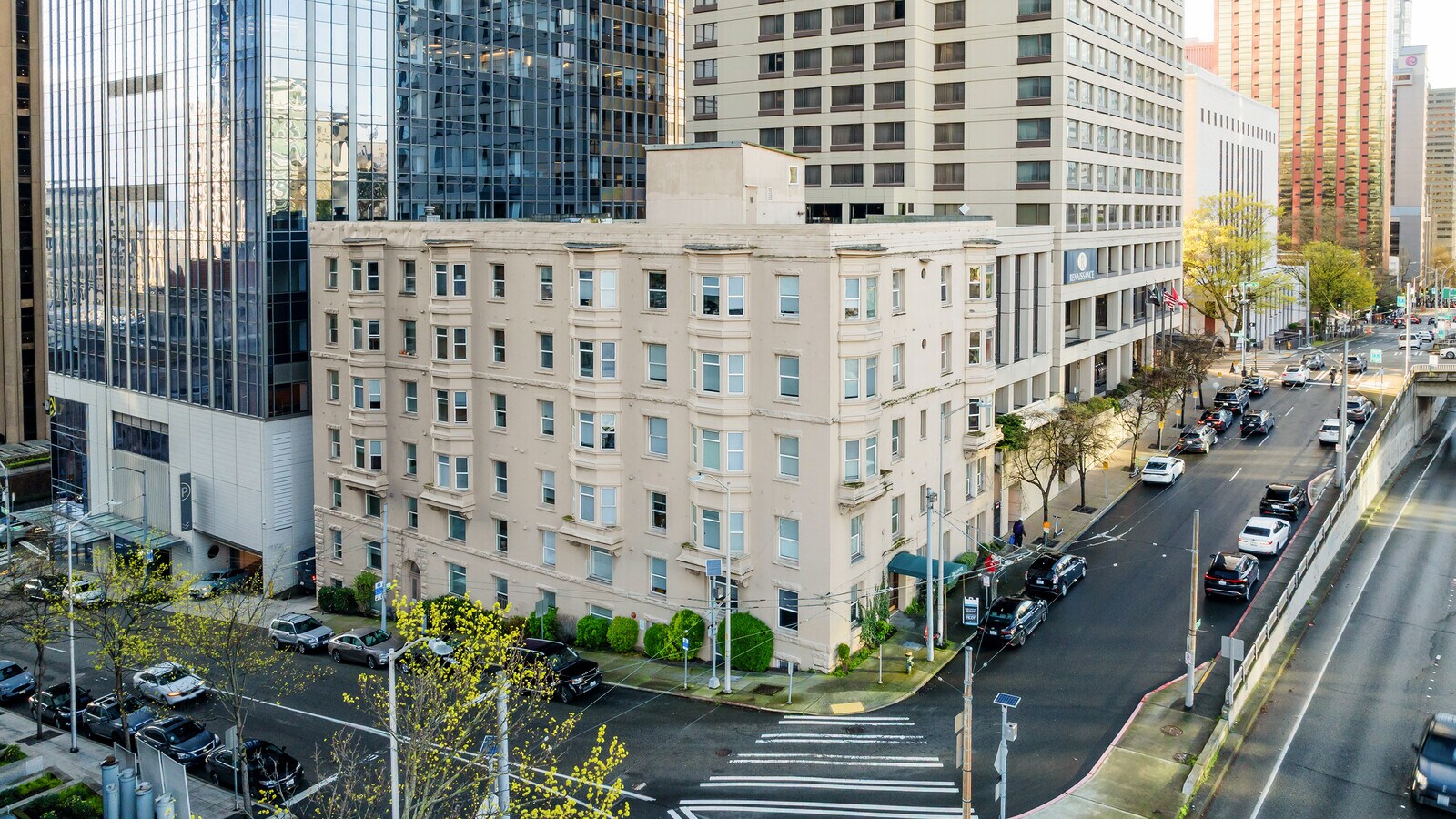
Parking downtown is expensive, and a monthly space can quietly rival a meaningful slice of your rent. So the question worth asking before you sign a lease isn’t “where will I park?” — it’s “can I skip the car entirely?”
In most of the country the honest answer is no. Downtown Seattle is one of the exceptions. But “walkable” gets stamped on a lot of listings that don’t deserve it, so it helps to know what to actually check.
Start with the two scores — then read past them
Walk Score and Transit Score are the fastest first filter. Both run 0–100:
- Walk Score estimates how many daily errands you can run on foot. Above 90 is generally described as a “walker’s paradise” — most errands don’t require a car.
- Transit Score measures the usefulness of nearby public transit, weighted by how frequent and how close the lines are. 100 is the top of the scale.
For context, Dover Quarters at 901 6th Avenue carries a Walk Score of 98 and a Transit Score of 100.
Here’s the catch: these are neighborhood-level signals. Two buildings four blocks apart can share a score while having very different daily realities — one is a flat walk to a station, the other is uphill both ways. Seattle’s topography makes this less of a joke than it sounds. Use the scores to shortlist, then check the specifics below.
The five distances that actually shape your week
Ask for walking times to these, not driving times:
- Your nearest frequent-transit stop. Not just any stop — one served often enough that you don’t plan your life around a timetable. From 901 6th Avenue, Symphony Station is about a 7-minute walk, with streetcar and bus stops roughly 2 minutes out.
- A full grocery store. A corner market covers a forgotten onion. It doesn’t cover a week.
- Your actual commute. Downtown puts you within walking distance of major tech and healthcare employers — Harborview Medical Center is about 10 minutes on foot from 901 6th Avenue. If you can walk to work, transit becomes a backup rather than a dependency, which is a materially different life.
- A “third place” you’d actually use. A library, a gym, a park, a café you like. Seattle Central Library sits about 4 minutes from 901 6th Avenue; Pike Place Market is around 15.
- A highway on-ramp. Even car-free renters take trips. Being near an on-ramp makes a rental, a rideshare, or a visiting friend painless — the I-5 on-ramp is two blocks from 901 6th Avenue.
What replaces the car
Going car-free downtown usually means assembling a few things rather than finding one substitute:
- Light rail and streetcar for predictable, traffic-immune trips along the corridor.
- Buses for everything the rail lines don’t reach.
- Rideshare or car-share for the occasional bulky errand or late night. Budget for a handful of trips a month rather than assuming zero.
- Delivery for the grocery runs you don’t want to carry uphill.
Run the arithmetic honestly. Add a transit pass, a realistic number of rideshare trips, and occasional delivery fees, then compare that against a car payment, insurance, gas, maintenance, and downtown parking. For a lot of downtown renters the comparison isn’t close — but it’s your numbers that matter, not an average.
Storage is the quiet variable
The part people underestimate: without a car, your apartment absorbs everything a trunk used to hold. Bikes, luggage, seasonal gear, the box you open twice a year.
Ask two questions on every tour:
- Is there dedicated storage in the building, and what does it cost?
- Where do bikes live — a secure room, or a hallway you’ll be asked to clear?
A building with real storage makes a small furnished suite work. One without it turns your living room into a garage. Dover Quarters offers extra building storage for bikes, luggage, and seasonal items, alongside on-site laundry — another errand that stops requiring a trip.
A furnished suite changes the math too
If you’re moving into a furnished place, you’ve already removed the single biggest reason most people rent a truck: the move itself. At Dover Quarters, suites come with a bed, desk, chair, storage and a wall-mounted TV, and utilities plus WiFi are included in the rent. You can genuinely arrive with a suitcase.
That matters more than it sounds for a car-free plan. The hardest days for someone without a car are move-in and move-out. Take those off the table and the rest is just groceries.
Before you sign
Walk it yourself, at the hour you’d actually be walking it. Do the station route on a weekday evening. Carry a bag of groceries up the block you’d climb daily. Check the stop’s real frequency, not its existence.
Downtown Seattle can absolutely support a life without a car. Just make sure the specific building supports your version of it.