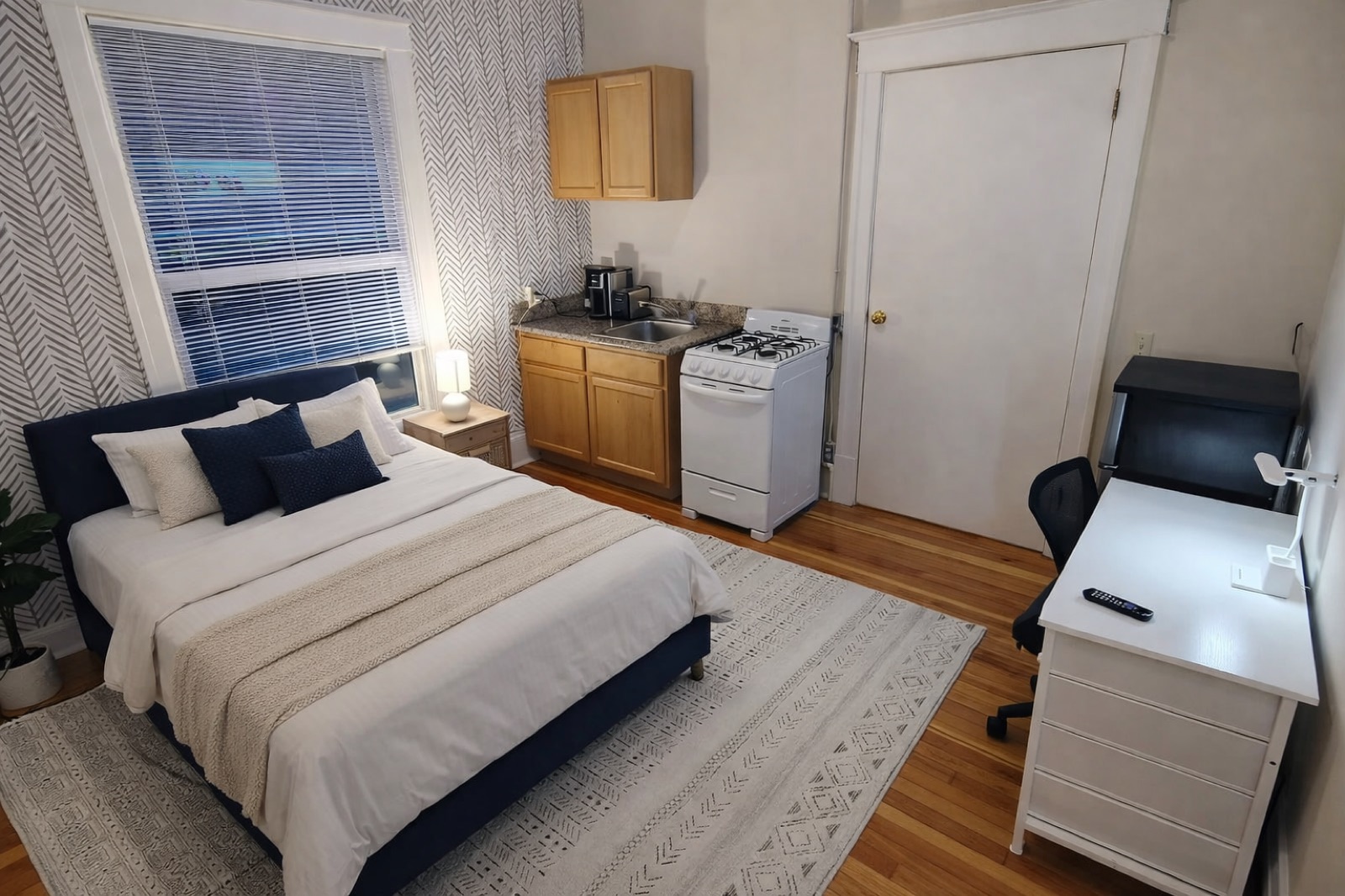
“Furnished” is doing a lot of unspecified work in most listings. It can mean a complete room you could move into this afternoon, or a mattress on a frame and nothing else. Both are advertised with the same word.
If you are searching this term, you have usually already made one decision — you are not buying furniture for this stay. So the only question left is whether a given listing actually delivers what that decision requires.
The week-one test
The fastest way to judge a furnished listing: what would you still have to buy in your first week?
If the honest answer includes a bed frame, a desk, a lamp or storage, it is not furnished — it is partly furnished, and the gap is yours to close in a city you may have just arrived in.
A room that passes the test has, at minimum:
- a bed you can sleep in the night you arrive
- somewhere to work that is not the bed
- storage for the things that came out of your suitcase
- lighting that does not require a trip to a hardware store
At Dover Quarters a suite includes a bed, desk, chair, wall-mounted TV and storage. Studio Jr suites add a private kitchenette; the other types share a full kitchen with granite counters and a stove.
The cost that never appears in the comparison
Put an unfurnished room and a furnished room side by side on monthly rent and the unfurnished one wins every time. That comparison is missing an entire column.
Moving into an unfurnished room means buying, at minimum, a bed, a desk and chair, storage and lamps. It means deposits on utility accounts, an internet installation appointment, and the first week of your time spent assembling things and waiting to be let in by technicians.
Now divide all of that by the length of your stay.
Across three years it is a rounding error, and you keep the furniture. Across four months it is frequently larger than the entire rent difference — and at the end you are selling a desk on the internet to somebody in the same position you were in.
The rule of thumb: the shorter your stay and the less you already own, the more decisively furnished wins. That is why the format concentrates around interns, students, people relocating, and anyone between longer-term homes.
Readiness is also about the accounts
Furniture is the visible half. The invisible half is everything you would otherwise have to set up in your own name.
Ask which of these are in the rent — all five, individually:
water · electricity · heat · garbage · internet
All five are included at Dover Quarters, so the quoted figure is the figure. Where a listing includes three of the five, that is a normal arrangement, but you now have two accounts to open, two deposits to pay, and two final bills to close when you leave. For a stay measured in months rather than years, that friction is a real part of the price.
What “all utilities included” actually covers goes through the checklist properly, including the questions that expose usage caps and who controls the heat.
Verifying the furniture you cannot touch
Most furnished rooms are rented sight-unseen, and the generic sight-unseen advice — walkthrough, written terms, never wire a deposit to a person — is covered under intern housing, where a programme deadline makes it most acute.
What that advice does not cover is the thing specific to this format: photographs are the worst possible evidence about furniture.
A wide lens makes a small desk look like a workstation. Staging photography routinely includes items that leave with the photographer — the rug, the lamp, the plant, sometimes the chair. And a photo set shot two years ago says nothing about the condition of what is in the room today.
So ask about the furniture in terms photographs cannot flatter:
- “Is every item in these photos included?” Ask it as a yes/no. The answer is sometimes no.
- “How wide is the desk?” A number, in inches. If a laptop and a notebook do not both fit, it is a table for keys.
- “What size is the bed?” Full, queen, twin. “Comfortable” is not a size.
- “Where do clothes go?” A closet, a wardrobe, a rail, or nothing.
- “How old is the mattress?” The one question nobody asks and everybody regrets.
On a video walkthrough, ask them to open the storage and pan slowly rather than sweep. Sweeping hides wear; a slow pan does not.
Dover Quarters runs in-person tours if you can get here — (253) 263-0612 — and applications are reviewed within 48 hours.
What furnished does not fix
Worth saying, because a page that only sells the format is not useful.
Furnished rooms are smaller than the apartment you would furnish yourself, and unless you take a suite with its own kitchenette you are sharing a kitchen. You are also renting somebody else’s taste. Over a long stay those things start to matter, and a conventional lease with your own furniture becomes the better deal.
Furnished is priced for readiness. Readiness is worth most when you need it soonest.